
5 Best Running Hydration Belts of 2026 (to Carry Water on Your Next Run)
Once your run stretches past an hour, carrying enough water stops being optional. Grabbing a bottle from your pack mid-stride is awkward. Holding a handheld the whole way tires your arm. Relying on water stops alone means rationing your effort around someone else’s schedule. A running hydration belt solves all three problems at once. It straps your water supply securely around your waist and keeps your hands free. You also get a small pocket for a phone and gels. This guide covers what sets a good hydration belt apart and how to match one to your distance and running style. It also gives you five picks worth your money.
Wondering how much you actually need? Our guide on how much water to drink when running breaks it down by run length.
What a running hydration belt is and why use one
A running hydration belt is a waist pack designed to carry water while you run. That distinguishes it from a standard running belt, which is built mainly for a phone and keys. A hydration belt either includes a built-in bottle holster for a hard bottle. Or it uses soft-flask pockets sewn into a wide band so fluid rides against your body rather than dangling at your sides.
The practical case for a belt over other options is straightforward:
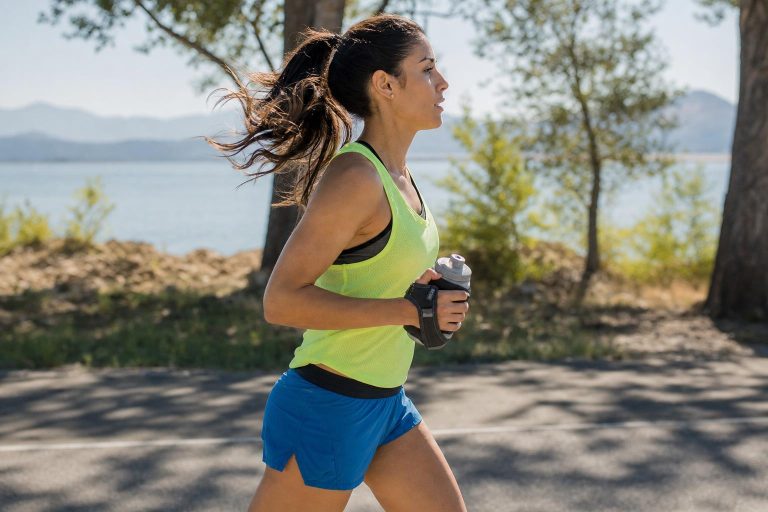
- No hands needed. You pull a bottle or sip from a flask without stopping your stride. Running with a handheld never quite allows that, especially when you also need to manage your phone or fuel.
- More fluid than a race singlet can carry. Shorts pockets and small belt pouches hold gels but not enough water. A hydration belt bridges the gap between a tiny pocket and a full running vest.
- Lighter and cooler than a vest. A vest holds more water, but it sits against your back and traps heat. For runs up to roughly two hours in moderate temperatures, a belt carries what you need without the extra weight or warmth on your spine.
- Storage for the rest of your kit. Most hydration belts include a zippered pocket for a phone, some cash, and a few gels. That makes them a genuine all-in-one option for a long training run or a race without dense aid stations.
Deciding between a belt and a handheld? Our guide to the best handheld water bottles for running walks through the tradeoffs.
How to choose a running hydration belt
Hydration belts share a basic concept but differ in ways that matter. These are the decisions worth making before you buy.
Soft flask or hard bottle
This is the most fundamental choice. Hard bottles sit in an angled holster on one or both sides of your waist. They are easy to grab and refill. The downside is that you feel the weight shift as you drink. A rigid bottle bouncing against your hip on rough terrain can get distracting. Soft flasks collapse as they empty, so the weight distribution shifts smoothly and the flask flattens to nearly nothing once drained. They tuck into sewn pockets along a band rather than hanging in a holster. That keeps the profile lower. Most serious long-distance runners prefer soft flasks for that reason. A hard bottle suits anyone who prioritizes quick refills and prefers not to squeeze their water out.
Total capacity for your distance
A rough guide:
- An hour of easy running in mild conditions calls for around 16 to 20 ounces.
- Longer efforts, heat, or hard effort ramp that up.
- A single 18 oz bottle covers most mid-length runs comfortably.
- Two 500 mL soft flasks give you roughly 34 oz combined. That gets you through a longer training run or a race with widely spaced aid stations without needing a vest.
If your longest runs are under 90 minutes, a single-flask design keeps things simple. If you routinely run two-plus hours, go with dual flasks or the highest-capacity single option you can find.
Fit and bounce prevention
A hydration belt carries more weight than a plain running belt, so fit matters even more. A loose belt sloshes, rotates, and digs in by mile three. Look for a high-stretch fabric that compresses against your body rather than hanging from it. Check that the sizing chart matches your actual waist measurement before ordering. Wider bands distribute the weight across more surface area and tend to stay put better than narrow ones. Some designs are deliberately wider at the front and narrower at the back, which helps on long efforts.
Storage for phone and fuel
Most hydration belts include at least one zippered pocket. The question is whether that pocket fits your phone. Check the pocket dimensions against your phone’s measurements, not just the marketing description. A pocket large enough for a mid-size phone might not fit a current large-screen model in a case. If your phone is your run tracker and emergency contact method, verify this before you order.
Comfort and chafe risk
Breathable fabrics (power mesh, high-stretch nylon blends) reduce sweat buildup and dry quickly. A wide band spreads pressure evenly. Seams that sit over your hip bones are a common chafe source on longer runs. Check the construction if you plan to run for multiple hours. Some runners apply anti-chafe balm along the band edge as a precaution regardless of the belt design.
The best running hydration belts
These five cover the main use cases, from a simple hard-bottle setup to a dual-flask band built for marathon distance. Match the pick to how you actually run, not just to whatever sits at the top of the list.
Nathan Peak Hydration Waist Pack: best with a hard bottle
Best for runners who want a hard bottle to grab and refill fast, on runs up to about two hours. The Nathan Peak carries an insulated 18 oz hard-sided bottle in an angled side holster. It holds the bottle securely without wobble on uneven ground. The expandable zippered pocket at the front fits a phone plus a few gels. That makes it a complete run kit for medium-distance efforts. The adjustable belt keeps the load in place across a range of waist sizes. Prefer the feel of a real bottle? This is the belt to start with. Take a look at the Nathan Peak price on Amazon to see current colors and configurations.
Naked Running Band (V2): best for soft flasks and no bounce
Best for runners who have fought belt bounce before, and anyone who wants a hydration option that disappears once the run starts. The Naked Running Band is a wide power-mesh band that wraps your waist like a second layer of compression fabric. Open pockets spaced around the band hold soft flasks, your phone, and gels. The weight sits distributed evenly and the fabric compresses against you rather than hanging off you. Bounce is minimal even when the pockets are fully loaded. It suits runners who want to carry water without feeling like they are carrying water. If you are familiar with the Naked band from our guide to the best running belts, this is that same concept applied to hydration. You can check the Naked Running Band price on Amazon to see the V2 and size options.
CamelBak Ultra Belt: best high capacity
Best for runners on longer runs or races who need more fluid between refills, plus room for a phone and snacks. The CamelBak Ultra Belt holds soft flasks; capacity depends on the flask size you choose. A zippered pocket fits a phone plus a good supply of gels and snacks. That makes it a genuine go-long option without committing to a full vest. CamelBak’s running gear tends to be built for durability and extended use, and the belt reflects that. If your runs regularly push past 90 minutes and you want everything on your waist rather than your back, this is the pick. Have a look at the CamelBak Ultra Belt price on Amazon for current availability.
Ultimate Direction Ultra Belt: best balance of water and storage
Best for runners who want serious capacity without giving up storage, and who need the load to stay flush rather than swinging. The Ultimate Direction Ultra Belt holds two 500 mL soft flasks, giving you roughly 34 oz combined before a refill. It also has a zippered pocket roomy enough for a current-generation smartphone and several gels. The high-stretch fabric keeps everything compressed against your body. Two full flasks do not translate into the pendulum effect that undermines cheaper belts on longer efforts. If you are training for a marathon and want to cover long runs self-supported, it has the capacity and stability to handle it. You can check the Ultimate Direction Ultra Belt price on Amazon to compare sizes.
UltrAspire Fitted Race Belt 2.0: best budget and race belt
Best for runners who want a light, simple belt for races or shorter runs, without paying for premium features. The UltrAspire Fitted Race Belt 2.0 is wider across the front than the back. That reduces pressure on your abdomen during hard efforts and keeps the belt from digging in on long races. It is genuinely light and low-profile. That is why it has a following among runners who want just enough water to bridge aid stations. No bulk, no excess. Running a race with decent aid station coverage? This is the practical, cost-conscious choice for a backup supply and gel storage. Take a look at the UltrAspire Fitted Race Belt 2.0 price on Amazon to see the current options.
Hydration belt vs handheld vs vest
Once you decide to carry your own water, the next question is which format suits your running. There is no single right answer, but the tradeoffs are clear.
A handheld bottle is the simplest possible setup. You grab a bottle, you run. The problem is that your arm works to hold it the entire time, and your hand grip affects your running form over long efforts. It also gives you no place for a phone or gels without stuffing your shorts. For runs under 45 minutes where you just want a quick sip option, a handheld is fine. For anything longer, most runners find it tiring.
A hydration belt is the hands-free middle ground. It frees your arms, carries a phone and fuel alongside water, and keeps the load at your waist where the weight is most manageable. The limitation is capacity. A belt covers runs up to roughly two hours depending on conditions. It does not carry the volume a vest can. It is the right tool for most training runs and races with well-spaced aid stations.
A running vest carries the most water, typically one to two liters via a reservoir bladder, plus ample storage for gear. The tradeoff is weight on your back, reduced airflow, and a larger piece of kit to manage. For ultras, mountain runs, or any effort where you cannot count on a refill for hours, a vest is the correct answer. For everyday road running up to marathon distance, most runners find it more than they need.
The summary: belt for most runs, handheld for a short easy effort, vest for long mountain or ultra distances.
How much water to carry running
There is no single formula that applies to every runner and every day. Sweat rate varies significantly between individuals and conditions. That said, a few practical benchmarks help with planning:
- Under 45 minutes in mild weather: most runners do not need to carry water. Hydrate before you leave.
- 45 to 90 minutes: 16 to 20 oz is a reasonable amount for moderate effort in typical conditions. A single soft flask or a small hard bottle covers this range.
- 90 minutes to two hours: 20 to 32 oz, depending on heat and pace. Two soft flasks or a higher-capacity single bottle.
- Over two hours: needs increase with duration and conditions. Two 500 mL flasks (about 34 oz) plus any course aid stations is a reasonable starting point for marathon training runs. Hot or humid conditions push that higher.
The key signal is your thirst and urine color after the run, not hitting a specific number. If you finish dehydrated, carry more next time. If you are carrying a mostly full flask home every run, you are carrying more than you need.
How much fuel to carry on a long run
Fluid is only half of a long run. Past about an hour, your body also needs carbohydrate, and that is what energy gels deliver. The general guideline is 30 to 60 grams of carbs per hour for most runners, building toward the higher end only once your gut is used to it. Use the tool to estimate how many gels to pack, then carry them in the same belt as your fluid.
Long-run fuel calculator
Estimate the carbs and energy gels to carry. Updates as you type. A planning guide, not a strict target.
Carbs mainly matter on runs longer than about 75 minutes. Based on roughly 22 g of carbs per gel, so check your brand. Start at the lower end and build up. More fuel is not automatically better.
Running hydration belt FAQ
What is the best running hydration belt?
It depends on your distance and how you prefer to carry water. For a single hard bottle and a secure fit, the Nathan Peak is the easiest recommendation. For soft flasks with low bounce, the Naked Running Band or the Ultimate Direction Ultra Belt are where most distance runners land. The UltrAspire Fitted Race Belt 2.0 is the right call if budget or race-day simplicity is the priority.
How do I stop my hydration belt from bouncing?
Tighten it more than feels natural at the start of your run. Belts that feel fine standing still often loosen once you pick up pace and the load shifts. Wear it snug at your natural waist. Choose a high-stretch fabric that compresses against your body rather than hanging. Balance the load evenly if your belt has multiple pockets. A single heavy bottle on one side with nothing on the other is a common cause of the sideways swing that makes belts annoying.
Hydration belt vs running vest: which is better?
For most runners and most distances, a belt is the more practical choice. It carries enough water for runs up to two hours, keeps the load off your back, and is lighter and cooler than a vest. A vest wins when you need more than a liter without stopping. That mainly applies to ultras, mountain runs, and long trail efforts in remote terrain. Our comparison above covers the full tradeoff.
Can a hydration belt carry my phone?
Most of the belts in this guide include a zippered pocket for a phone, but pocket size varies. The CamelBak Ultra Belt and the Ultimate Direction Ultra Belt both have pockets described as large enough for a current smartphone plus snacks. The Nathan Peak’s pocket is expandable but on the smaller side for large modern phones. Check the pocket dimensions against your specific phone before ordering.
Is a hydration belt good for marathon training?
Yes, for the majority of long training runs. The key is matching capacity to your route. For a 20-mile long run in summer heat, two 500 mL flasks give you about 34 oz on your body. Add whatever you grab at planned water stops. Belts like the Ultimate Direction Ultra Belt and the CamelBak Ultra Belt are designed with exactly this use case in mind. For aid-station-dense road marathons on race day, some runners switch to a lighter race belt and rely on the course.
Bottom line
The right hydration belt matches your distance, stays put, and carries water in a format you are comfortable with. For runners who want a classic hard-bottle setup, the Nathan Peak is a solid starting point. If bounce is your main concern and you prefer soft flasks, the Naked Running Band is hard to beat. When capacity matters, the Ultimate Direction Ultra Belt is the workhorse of this group. It has dual flasks and a roomy storage pocket. The CamelBak Ultra Belt is the alternative if you want a familiar brand at similar capacity. The UltrAspire Fitted Race Belt 2.0 is the choice when you want light and simple without overpaying. Measure your waist, pick your distance, and match the belt to the run you actually do.